
You know that chorus you never chose to learn. It followed you into the shower, into the car, and you were singing it before you even knew what the song was about. That isn't luck: a chorus that sticks is built to stick, and the recipe comes down to a handful of rules.
Here is what makes a good chorus, how long it should be, five concrete techniques with examples written for this article, and how to apply them to a song you give as a gift. And, to move from theory to the ear, how you write, test and fix a chorus in the Tubissime Studio.
What makes a good chorus
A chorus has one job: to be remembered. The verses tell the story, the chorus sums it up. It comes back two, three or four times, almost unchanged, and that repetition is what burns it in. If you keep only one rule: a chorus says one idea, in few words, and says it more than once.
Three ingredients show up in almost every chorus that works. Repetition first: a word or a line that comes back inside the chorus itself. Then the hook: a short phrase, often on the first or last line, that you can sing without knowing the rest. Finally contrast: the chorus sounds bigger than the verse, higher, simpler. A personalised song adds a fourth one, the name, which is the best hook there is: it's the word the person recognises before any other.
Verses get read. A chorus gets sung without thinking.
Length and syllables: how many words in a chorus?
A pop chorus fits in four lines, sometimes eight when it repeats itself. Count on 20 to 30 seconds. Shorter, and it slips by unnoticed; longer, and it turns into another verse that nobody remembers in full.
The real setting is the syllable count. A line of 7 to 10 syllables sits comfortably in the mouth; at 14, the singer has to swallow half the words, and that is exactly what makes a chorus impossible to sing along to. Keep your lines close in length from one to the next: the ear spots the pattern and starts to anticipate.
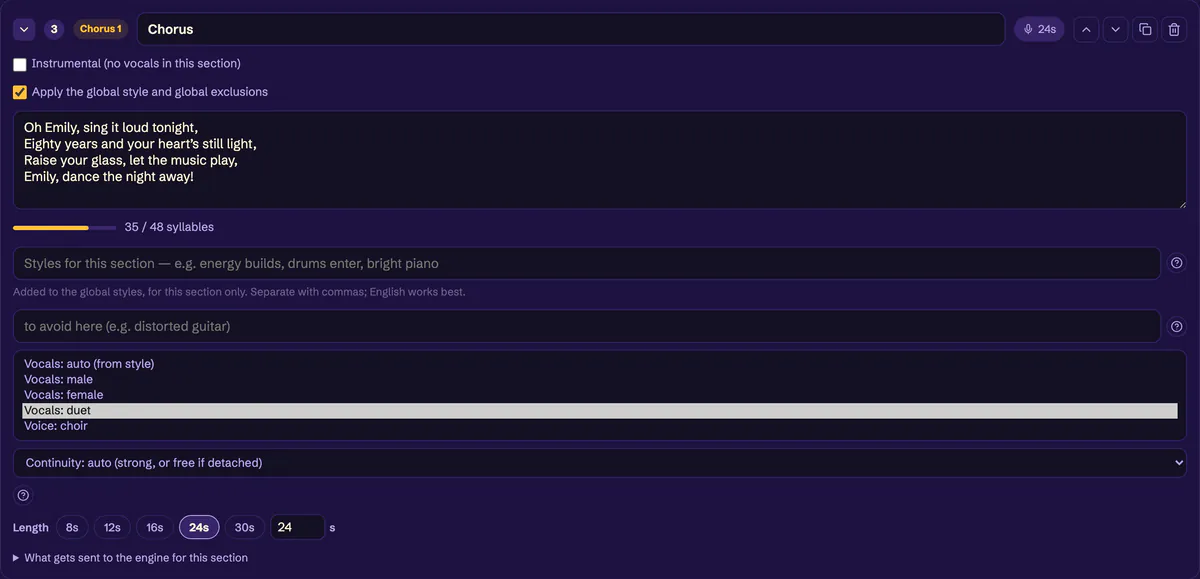
In the Studio, that arithmetic is done for you. Under each section's lyrics, a counter shows how many syllables you've written and how many the section can hold, which depends on its length. A 24-second chorus holds around 48 syllables. If the counter overflows, cut words or lengthen the section, rather than hoping the singer will speed up.
5 techniques for a chorus that sticks
1. Open or close on the hook
Put the key line first or last, never in the middle. That's the line people remember, so it needs the strong position. Better still, use both: "One more time, Lucy, / we'll fix the whole world till the dawn, / cold coffee, laughing on and on, / one more time, Lucy." Even without the rest, everyone will sing the first and last lines.
2. Repeat, then land it
The most effective pattern: a repeated line, a line that moves forward, the same repeated line, a line that lands. The ear records the repetition, then waits for the payoff. "You dance, you dance, / even when the music's gone, / you dance, you dance, / and the whole room sings along." Four lines, two ideas, one to remember.
3. Simple words, open vowels
A chorus is sung loud, often by several people at once. Short words and open vowels (ah, oh) hold a long note better than stacked consonants. "Come on home" gets sung; "notwithstanding our constraints" gets recited. Save the rich vocabulary for the verses, where people actually listen to the words.
4. A concrete image, not a big feeling
"I love you so" sticks nowhere: everyone has heard it a thousand times. "Your old blue sweater on my shoulders" sticks at once, because you can see it. A chorus can name the feeling, but it holds it with an object, a gesture or a place.
5. Simple rhyme, steady rhythm
An obvious rhyme at the end of a line helps memory: that's the whole power of nursery rhymes. You don't need clever rhymes, a near rhyme will do. Rhythm matters more: if the lines have roughly the same number of syllables and the stresses fall in the same places, the chorus is singable by the second time round. In the Studio, the writing coach suggests stronger rhymes and a steadier rhythm without changing the meaning.
The chorus of a gift song
In a song you give, the chorus is the moment everyone looks up. That's where the name goes, ideally on the first or last line, and twice if you can: it's the word the room will sing back even without knowing the rest. Check that it sings well: a three-syllable name won't fit in the same line as a one-syllable one.
The memory itself belongs in the verses. The chorus keeps just one detail, the most shareable one: the nickname, the catchphrase, the place everyone knows. "Marco, Marco, king of the barbecue" will get the whole table singing; the full story of the 2018 barbecue belongs in the second verse. To spread the story across verses, bridge and chorus, see song structure, block by block.
One last setting: the voice. In the Studio, you choose it section by section. Solo verses and a duet chorus, or even a choir, and the chorus sounds like a shared moment instead of a repeat.
Test it and fix it in the Studio
A chorus isn't judged on paper. It's judged on the second listen: if you're already humming it, it works. If you need to reread the lyrics to follow it, it's too long, too dense or too abstract.
In the Studio, each section is its own block, with its lyrics, voice and length. Write the chorus yourself, or ask Mélodie, the writing assistant, in plain language: "make the chorus shorter", "put the name at the start". She reworks that section, not the whole song. The full method, from the starting story to the final lyrics, is in how to write a song with AI.

Once the song is composed, if the chorus doesn't hold up to the ear, you redo that part only. Only the reworked section is recomposed, with the same voice across the rest of the song, and the original version stays available. One thing to know: a fix is charged on the song's total length, at 42 credits a minute, not just on the chorus. So it pays to sing the chorus out loud before composing rather than correct it afterwards.
The mistakes that make a chorus forgettable
- A chorus that tells a story. If you need the backstory to understand it, it's a verse.
- Too many syllables. If the counter overflows, cut one word per line before touching anything else.
- The name buried mid-line. Put it at the start or end of the line, or it slips past unheard.
- A different chorus every time. Nobody can sing along to something they've never heard twice.
- Big abstract words. "Happiness", "forever", "destiny": forgotten before the song even ends.
Frequently asked questions
How many lines should a chorus have?
Four, most of the time, for 20 to 30 seconds. Eight lines can work if the last four repeat the first four with a variation. Beyond that, the chorus becomes a verse and nobody remembers it in full.
Does a chorus have to rhyme?
It helps, but it isn't required. A simple rhyme or a near rhyme at the end of each line makes it easier to remember. Rhythm matters more: lines of similar length, with the stresses in the same places, stick even without rhyme.
Where should the name go in a personalised song?
In the chorus, on the first or last line, ideally twice. It's the word everyone recognises and sings back. To hear it in context, listen to a full personalised song demo.
I just want to give a song: do I have to write the chorus myself?
No. The gift plans handle everything for a fixed price, with no account: you tell the story, and the chorus is written around the name. The Studio is for people who want to shape it themselves, word by word.
The takeaway
A good chorus says one idea, in four lines, and repeats it. Put the hook first or last, keep the words simple and the lines even, choose a concrete image over a big word, and place the name where everyone will sing it. Then judge it by ear, not on paper. To write it, hear it and fix it section by section, create your Studio account.